Article
What 2026 Holds for Calgary Commercial Real Estate
February 3, 2026 4 Minute Read


Calgary provided optimism for a commercial real estate industry searching for good news in 2025, with its office and industrial markets remaining relatively stable despite macroeconomic uncertainty.
Downtown office vacancy stayed elevated at 30.4% in Q4, down slightly from the previous quarter. Meanwhile the Calgary industrial market saw availability fall to 5.3%, with 1.9 million sq. ft. of new supply delivered and 3.6 million sq. ft. of new space still to be delivered.
We checked in with CBRE Calgary Managing Director Michael Hoffman to see what he’s watching for in 2026.

Office Stays Steady
We continue to deal with elevated office vacancy rates, around 30% in the downtown core and 19% for the suburban market by year’s end. There has been a lot of office leasing activity but most of it has been renewals of existing locations or moving into new buildings. We haven’t seen a significant amount of net new absorption by office tenants coming into the market.
The flight to quality continues in our office market, with AA office buildings about 10 points better on occupancy, so just under 20% in the AA space versus the rest of the market at around 30%.
The biggest challenge facing Calgary office is mergers and acquisitions activity in the oil and gas sector. In 2024 we had Chevron Canada purchased by Canadian Natural Resources (CNRL) for $6.5 billion. Then in 2025 Parkland was acquired by Sunoco for $9.1 billion; Veren Inc. was acquired by Whitecap Resources Inc. for $15 billion; and MEG Energy Corp. was acquired by Cenovus Energy Inc., a $7 billion-plus deal. When these acquisitions happen, a rationalization of space inevitably happens. So there will be a lot of sublease space on the market as a result.
Calgary has the most office conversions completed or planned of any Canadian cities. Thirteen have been completed – two are hotels, ten are residential and one for a school use. Another nine buildings are under construction and seven more are in the planning stage. That’s a total of 29 conversion projects for 3.2 million sq. ft., 2.4 million sq. ft. of it in the downtown core. It’s helping reduce the downtown vacancy rate but it’s not going to bring us back to a normalized level of office vacancy. The picture would be worse without conversions.
Industrial Gathers Momentum
It was a very slow start to 2025 for Calgary’s industrial real estate market due to economic uncertainty and tariff talk. It was tough for industrial users to expand or make decisions up until Q4. By September deal activity had ramped up as companies needed to solidify their real estate needs for the future; they just couldn’t sit on sidelines any longer.
New industrial development last year was minimal, at just over 1 million sq. ft. But we’re expecting to see further development in 2026 as momentum picks up and new users enter the market.
The continued growth of Calgary industrial real estate is primarily due to the cost of real estate here and the relative cost savings compared to other major markets like Vancouver or Toronto. Calgary’s central location makes it a good spot for distribution for Western Canada and even northern parts of the U.S.
Retail a Bright Spot
Retail has been one of the bright spots in Calgary. Retail vacancy is relatively low with strong demand, both in large users and small commercial retail units. Last year we saw some new development which is alleviating some of that pent-up demand. However in 2026 we’re expecting to see future development in outlying areas as new communities grow beyond the core of Calgary.
We continue to see new entrants into Alberta and Calgary, mostly U.S. operations. Last year we saw Chick-fil-A and the return of Krispy Kreme and this year we’ll see the arrival of Jersey Mike’s Subs.
Multifamily Works Through New Supply
There has been a significant amount of multifamily supply added over the past five years which is attempting to catch up to the amount of demand growth we’ve had. But immigration last year was at about one-third of what it was in 2023 and 2024. So new multifamily starts have been reduced to match the reduction of immigration coming into Calgary. Rental rates plateaued in 2025 largely due to those two factors: increased supply and reduced in demand.
New construction is benefiting from the support of Canada Mortgage and Housing Corp. (CMHC) financing; however larger steel and concrete projects are being replaced with four- to six-storey woodframe construction. Larger projects going beyond six storeys would require steel and concrete and add extra parkade space at significant cost.
Private Investors Drive Deals
Last year was a very strong year for Calgary commercial real estate investment and I don’t see why 2026 will be any different. Alberta had the attention of investors as our economic prospects looked more encouraging than other Canadian markets. Demand is strongest from private investors and some institutional players. All asset classes, be it industrial, grocery-anchored retail, multifamily, have seen increased activity.
It comes down to the price per square foot in Calgary when you compare it to other Canadian markets. There is still good value to be had here. And with higher cap rates compared to Vancouver and Toronto, in a lower interest rate environment, there is an opportunity for investors to find great product in Calgary.
Recent Insights
-
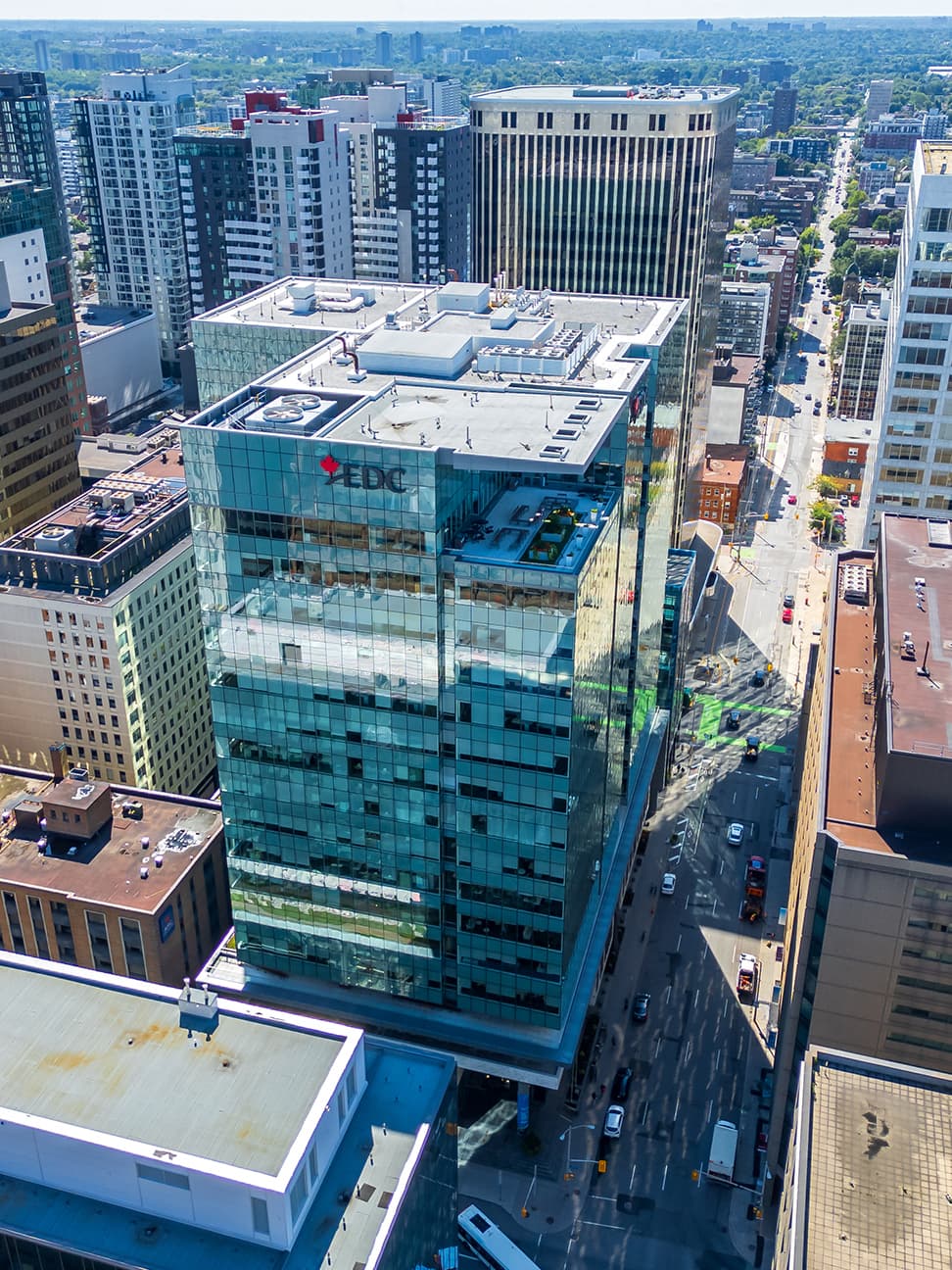
CBRE recently brokered the sale of 150 Slater St., a 447,448 sq. ft., Class A office tower in the heart of the capital’s financial district.
-
Article
CBRE Canada CEO Jon Ramscar: Investors Have a Golden Opportunity to Access Vancouver Real Estate

Jon Ramscar told the Vancouver Real Estate Forum today that there is a compelling reason to have renewed confidence in the city’s prospects: Access.
-

The seven-storey office building is being built on top of a restored former 100+ year old warehouse, combining the aesthetic of a century-old brick and beam structure with the functionality and sleekness of new, state-of-the-art office space.
Stay In The Know
Subscribe today and join hundreds of professionals who get the latest blogs delivered straight to their inbox.